
Opportunities for enhanced EU–India cooperation on climate adaptation
- Authors: Namrata Kabra and Aditi Mukund
Publication Date: June 2026
Disclaimer: The views expressed in this article are those of the authors and do not necessarily reflect the views of their affiliated institutions. The authors write in their personal capacity.
A pdf of this policy brief may be found under this link, or at the end of this page.
***
Introduction
The impacts of climate change in India are no longer abstract projections but a lived and intensifying reality. During the first nine months of 2025, India experienced extreme weather events on 99% of days, including heatwaves, floods, cyclones, landslides, and lightning strikes. According to the Annual Climate Report 2025 by the Centre for Science and Environment (CSE) and Down to Earth, these events resulted in 4,064 deaths (compared to 3,238 in 2024), affecting millions of people, and damaging over 47 million hectares (3.2 million hectares in 2024) of cropped area; these developments reflect a sharp escalation in both frequency and intensity compared to previous years. The cascading impacts on livelihoods, public health, infrastructure, and economic productivity underscore the urgency of moving from incremental climate responses to a more structured, adequately financed, and forward-looking adaptation framework.
These compounding impacts reinforce a growing understanding that climate change in India is, at its core, a security issue. Its consequences reach into human security, food and water systems, health, and the overall stability of regions already under socio-economic stress. The policy responses on climate action have been skewed towards mitigation. However, the recent updates to India’s Nationally Determined Contribution (NDC) and the agenda of its ongoing BRICS presidency signal a shift towards people-centric and community-led adaptation, as growing impacts on lives and livelihoods demand.
India and NDC 3.0
In March 2026, India approved its Nationally Determined Contribution (NDC) for the 2031–2035 period, known as NDC 3.0 under the Paris Agreement, setting out an enhanced climate trajectory. The official document for the NDC 3.0 is yet to be released. According to the press release, India has strengthened its mitigation commitments by targeting a 47% reduction in emissions intensity of GDP from 2005 levels by 2035 (up from 45% by 2030), and 60% cumulative electric power installed capacity from non-fossil fuel sources by 2035 (up from 50% by 2030). On land-based mitigation with adaptation co-benefits, the carbon sink target through forest and tree cover has been increased from 2.5–3.0 billion tonnes of CO₂ equivalent by 2030 (NDC 1.0) to 3.5–4.0 billion tonnes by 2035 – a goal that was not updated in the NDC 2.0 in 2022.
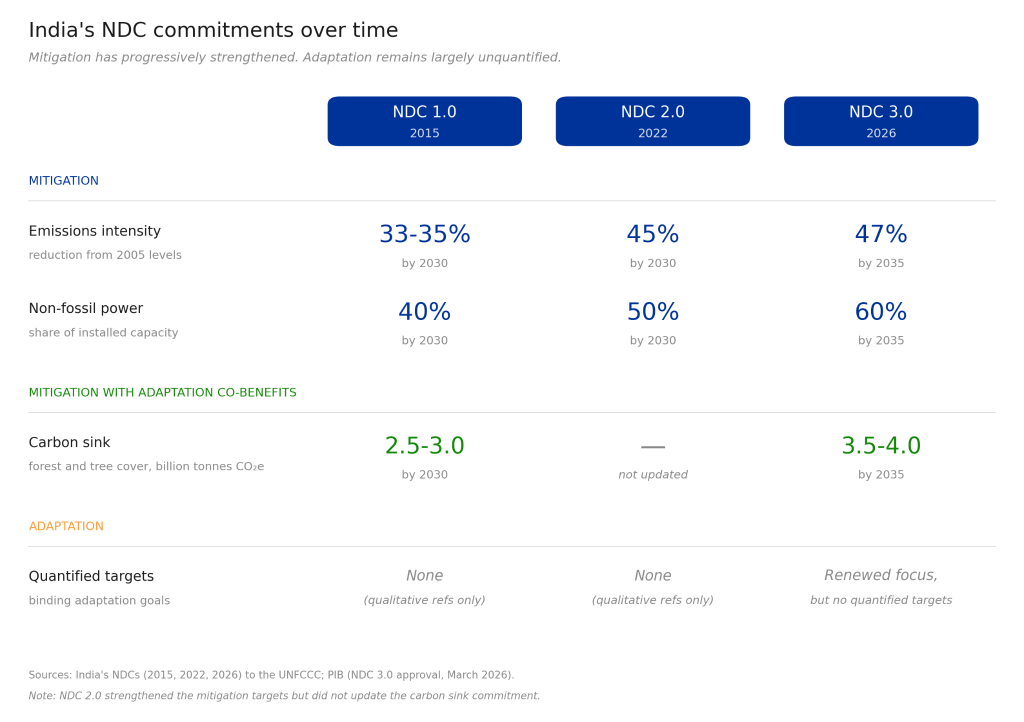
NDC 3.0 has renewed the focus and iteration on the need for adaptation through climate resilient infrastructure and missions under the National Action Plan on Climate Change (NAPCC). From a constitutional perspective, these commitments are consistent with the Supreme Court’s recognition, in M.K. Ranjitsinh v. Union of India, of a “right against adverse impacts of climate change” – a ruling that can be read as establishing a right to climate adaptation.
However, there continue to be significant gaps at the institutional, policy, and financing levels when it comes to adaptation. By contrast, India’s success on mitigation, particularly in reducing emissions intensity and scaling up renewable energy, serves as a global case study. With clearly defined and measurable targets, strong inter-ministerial coordination, and increasing private sector participation, India has consistently met its mitigation commitments, and the targets set out in the latest NDC 3.0 are also on track to be achieved ahead of schedule. While mitigation in India is target-driven and investment-backed, adaptation remains far less structured without clear targets, dedicated budgets, and robust monitoring mechanisms.
This is not without reason. The one clear adaptation-related target under NDC 1.0 (2015) to enhance forest and tree cover has proven difficult to achieve, largely due to increasing land-use pressures from rapid urbanisation, expanding linear infrastructure, and limited access to adequate adaptation finance.
State of adaptation: gaps and opportunities
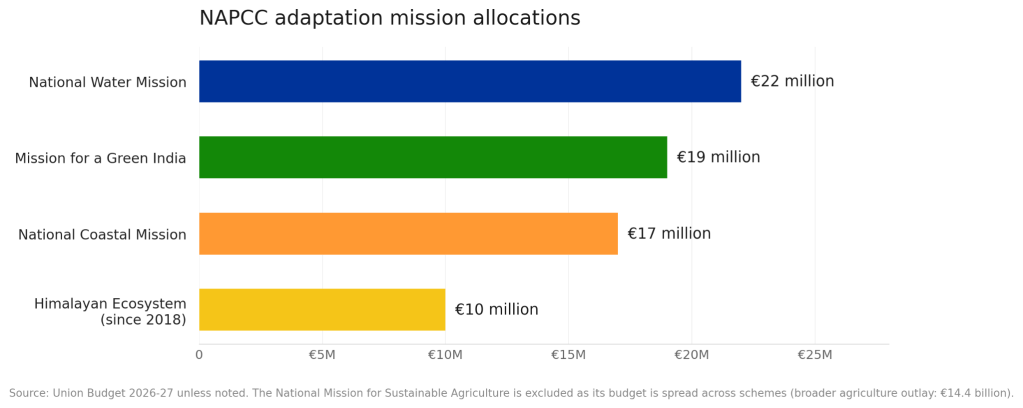
Within the expanded NAPCC framework, five out of ten missions are focused on adaptation. However, the funding and implementation of these missions remain modest. For instance, the Mission for a Green India has an allocation of ₹212 crore for 2026–27 (€19 million), but only 28% of funds were utilised in 2025–26; the National Water Mission has an allocation of ₹243 crore (€22 million), with its impact tied to research, development, and implementation of the mission; the Mission for Sustaining the Himalayan Ecosystem does not have a dedicated annual budget and only ₹111.63 crore (€10 million) has been sanctioned since 2018. By comparison, the budget for the National Mission for Sustainable Agriculture is difficult to track. However, for agriculture and its allied activities, there is an outlay of ₹1.62 lakh crore (€14.4 billion) in the current budget cycle 2026–27 spread across multiple schemes. Lastly, the National Coastal Mission, operationalised in 2022 with an initial outlay of ₹195 crore (€17 million) for 2022–23 and significant reliance on externally aided projects, now functions with minimal and inconsistent funding.
At a broader level, India spends significantly on adaptation-related sectors, but this spending is scattered and difficult to track. The National Adaptation Fund for Climate Change (NAFCC) reflects this gap clearly: while ₹847.48 crore (around €75 million) worth of projects have been sanctioned, of which ₹541 crore (€48 million) have been released, the fund has not grown into a major financing tool. Since 2022, the fund remains without strong budget visibility or expansion while adaptation costs continue to rise. According to the 2024–2025 Economic Survey, adaptation-related expenditure increased from 3.7% of GDP in 2015–16 to 5.6% in 2021–22; this amounts to roughly ₹13 lakh crore (€115–119 billion) in 2021–22, but remains far below what is needed. India’s preliminary adaptation financing need was estimated at USD 206 billion (€177 billion) for the 2015–2030 period under its first NDC in 2015. The updated estimate, per the 2024–25 Economic Survey, puts the requirement at ₹56.68 lakh crore (approximately €500 billion) by 2030 as submitted in India’s first Adaptation Communication to the United Nations Framework Convention on Climate Change (UNFCCC). The gap is therefore not just financial, but structural in terms of how adaptation is defined, funded, and governed.
Overall, without a clear legal and financial framework for adaptation including a formal National Adaptation Plan (NAP) – potentially being developed at the time of this writing – policy attention is skewed towards mitigation. This gap is also reflected in how adaptation is perceived in climate decision-making and in the lives of those impacted. In M.K. Ranjitsinh v. Union of India, the Supreme Court of India, in the spirit of upholding India’s climate commitments, permitted the expansion of renewable energy projects over the conservation of grassland habitat; the Court sought to balance “the intricate interface between the conservation of an endangered species, such as the Great Indian Bustard, and the imperative of protecting against climate change”. In Rajasthan, a 700-km march by hundreds of villagers protesting the impact of solar projects on sacred groves further highlights a growing conflict: large-scale renewable energy expansion is undermining community-managed ecosystems and livelihoods. This brings out a clear tension within climate governance: while mitigation efforts are being prioritised and fast-tracked, adaptation and ecological concerns are considered secondary.
Climate change recognises no boundaries, and neither can the response to it. No country can build climate resilience in isolation, and India is no exception, particularly given the scale of adaptation needs and the financing gap that domestic resources alone cannot close. Effective adaptation will depend on sustained collaborative work across borders, drawing on shared knowledge, pooled finance, technology transfer, and coordinated policy frameworks with like-minded partners, such as embedding climate action within EU–India bilateral priorities.
India’s NDC 3.0 therefore presents a timely opportunity to deepen cooperation with the EU. As a global leader in climate policy with strong financial, regulatory, and technological capacity, the EU is well placed to support the development of robust adaptation frameworks. Adaptation, thus, can be the next frontier of climate action and a critical area for cooperation. As India continues to lead on mitigation, stronger EU–India engagement on adaptation can align economic and climate priorities, ensuring climate action is grounded in hyperlocal resilience of people and ecosystems.
EU–India cooperation: climate action with co-benefits
A strengthened EU–India partnership must move beyond regulation to a model that aligns climate ambition with needs-based development priorities. Such a vision would centre on finance, technology, industrial collaboration, and co-development. In this context, India has already demonstrated global leadership by advancing on-ground resilience through initiatives such as the Coalition for Disaster Resilient Infrastructure, the International Solar Alliance, its engagement in the Indian Ocean Rim Association, and other climate platforms driving South-led cooperation on disaster risk reduction, maritime resilience, and climate adaptation.
If global climate action is to move from ambition to impact, EU–India cooperation on adaptation must become central. Such cooperation sits at the intersection of climate ambition and climate justice. The EU has both the capacity and responsibility to support resilience-building in climate-vulnerable regions like India, where impacts are already severe.
There are several entry points where climate action can deliver multiple co-benefits across sectors:
- India’s agro-meteorological advisory systems already demonstrate how early warning and climate information can support farmers in making better cropping decisions. Further, India has recently launched “Mission Mausam” (Mission Weather) with a goal to make India weather-ready and climate-resilient. With greater investment, these systems can be strengthened while promoting climate-resilient crops such as millets, improving nutrition, reducing water stress, and enhancing livelihood security. This is one area where deeper EU–India scientific cooperation could make a real difference. The Copernicus Climate Change Service (C3S), the EU’s main climate data service, is implemented by the European Centre for Medium-Range Weather Forecasts (ECMWF), making it a natural counterpart to the India Meteorological Department (IMD) on downscaled forecasting, seasonal prediction, and impact-based early warning under Mission Mausam. EU research funding through Horizon Europe could also support the development of AI-enabled, vernacular advisory tools tailored to smallholder farmers.
- Nature-based solutions present another strong area for cooperation, aligning with India’s enhanced target of creating an additional 3.5 to 4 billion tonnes of carbon sink. It is worth noting that nature-based solutions remain one of the most cost-effective ways to reduce climate-induced disaster risk. Expanding blue-green infrastructure in cities such as urban forests, wetlands, and green corridors can reduce heat stress, manage flooding, and improve overall liveability – and do so cheaply. In forested regions, strengthening ecosystem services and securing community forest rights can support both conservation and a just transition, especially in states moving away from fossil fuel-based economies. The EU’s Nature Restoration Regulation offers useful entry points for technical cooperation in this regard, particularly on monitoring and verifying ecosystem-based interventions. Co-financing through the European Investment Bank (EIB) and the EU’s Global Gateway strategy could support state-level pilots on urban blue-green infrastructure.
- Urban heat resilience is an equally urgent priority with rising urbanisation. Investments in affordable cooling solutions, climate-sensitive urban planning, sustainable building materials, and increased green cover, particularly in dense, low-income areas, can significantly improve public health, productivity, and quality of life. Instruments such as parametric insurance for women and low socio-economic groups can further help vulnerable communities cope with climate shocks. With around 250 heat action plans already in place across Indian municipalities, the EU’s Mission on Adaptation to Climate Change, which supports a network of European cities, offers a natural anchor for city-to-city partnerships. Joint work on urban green infrastructure, where Indian cities lag European counterparts on canopy cover and permeable surface design, is another clear entry point. The Indo-German Green Urban Mobility Partnership (GUMP), run jointly by the German Federal Ministry for Economic Cooperation and Development (BMZ) and India’s Ministry of Housing and Urban Affairs, can be expanded to cover heat resilience, cool roof programmes, and standards for low-carbon building materials. On insurance, the parametric heat scheme by the Self-Employed Women’s Association (SEWA) – which scaled from 21,000 to 50,000 women workers across Gujarat, Rajasthan, and Maharashtra in 2024 – dispenses automatic payouts triggered above 40°C, and offers a working model that European reinsurance and development finance can help scale.
Scaling these solutions will require sustained investment, institutional support, and global partnerships. The EU, with its financial and technological capacity, is well positioned to support this transition, not as a donor, but as a partner in co-developing adaptation pathways in India that are locally grounded and globally scalable.
Conclusion
At a moment when global climate leadership feels increasingly fragile, with attention and political capital pulled towards more immediate geopolitical concerns, the case for sustained EU–India cooperation on adaptation only grows. Other priorities will, understandably, continue to crowd the agenda – but climate remains one of the few areas where both partners share enough common ground, enough mutual interest, and enough complementary capacity to build the kind of trust that wider strategic cooperation will eventually require. By moving together on adaptation, the EU and India have an opportunity to prototype a different model of climate leadership, one grounded in equity, co-development, and on-ground resilience. In a world where climate ambition risks stalling, this partnership can serve as both a stabilising force and a demonstration of what is still possible.
***
Notes: All currency conversions to EUR are approximate and based on prevailing exchange rates at the time of writing, unless otherwise stated.
***
About the Authors
Namrata Kabra is a legal researcher specialising in climate security from an intersectional gender, water and bioregionalism lens. With over 10 years of experience across program strategy, regional coordination & policy in India & South Asia, her work focuses on designing climate programmes, institutional learning, and cross-regional collaboration. She contributes to advancing the public and policy discourse on gender-responsive climate law, policy and diplomacy. Namrata is an Associate Member of Generation EU-India.
Aditi Mukund is Co-Founder and Co-President of Generation EU-India. Her research explores the intersection of gender and security in EU-India relations and in the Indo-Pacific region. She was previously a German Chancellor Fellow with the Alexander von Humboldt Stiftung, based at the Global Public Policy Institute (GPPi), Berlin.

