21 June 2025 | Hertie School, Berlin
Generation EU-India hosted its first in-person event at the Hertie School on 21 June 2025. This milestone was far more than a policy conversation; it was a vibrant exchange that brimmed with intellectual curiosity, fresh ideas, and a deep sense of purpose.
In her opening remarks, Patrizia Cogo Morales, Co-President of GenEI, welcomed participants and expressed appreciation to all those who helped make the event possible. Patrizia Cogo reiterated GenEI’s core belief: that the voices of the Youth are not just those of the leaders of tomorrow, but the voices of active shapers of today’s strategic dialogues. She introduced the network’s first research publication, Capturing Talent, which explores how skilled labour can become a bridge between the EU and India—framing migration not as a challenge, but as a shared opportunity.
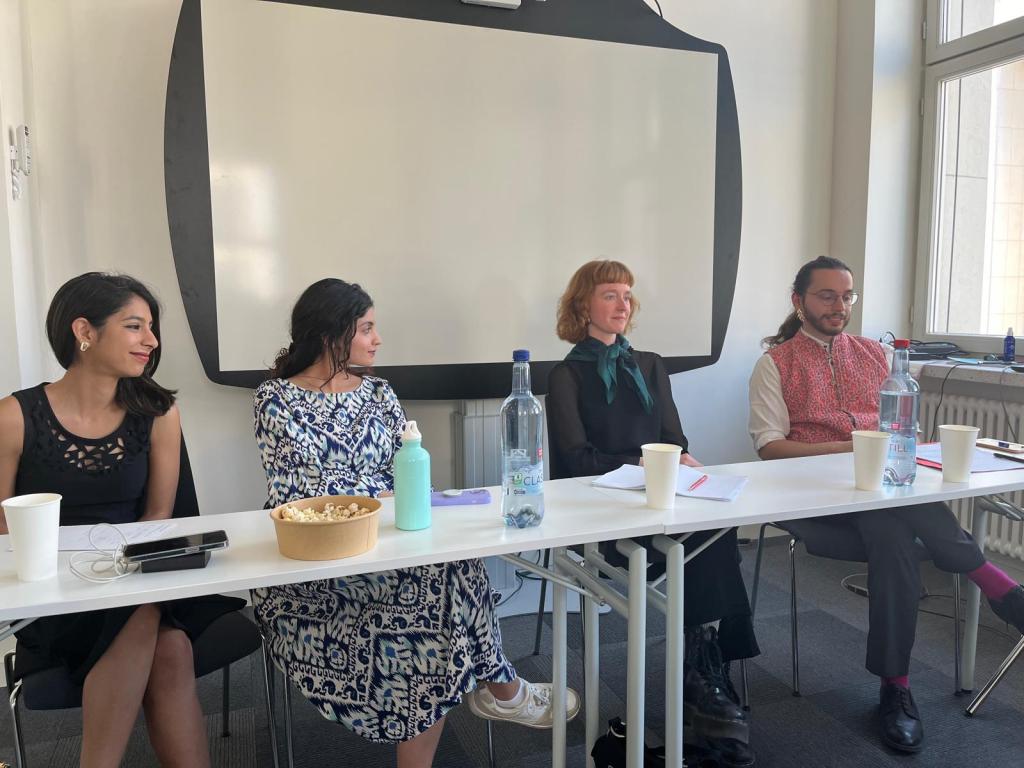
What followed was a panel discussion that proved to be both wide-ranging and deeply insightful. Titled Rethinking EU-India Relations in a Fractured World Order, the conversation—deftly moderated by GenEI’s Editor-in-Chief, Dimitrios Margellos—brought together three dynamic and sharp-minded panellists: Leona Harting (Körber Foundation), Dr. Sharinee L. Jagtiani (German Marshall Fund), and Aditi Mukund (German Chancellor Fellow and GenEI Co-President). Together, they peeled back the layers of the EU–India relationship through the lenses of diplomacy, technology, and institutional trust.
Leona Harting opened with a compelling reframing of India as a pivotal actor—an actor with its own agency in an increasingly multipolar world. Drawing on the Körber Foundation’s expert cross-country survey across India, Brazil, South Africa, and Germany, she emphasized that India’s non-alignment is not a sign of disengagement but a conscious strategic choice. Nearly half of Indian experts preferred a neutral stance over alignment with the U.S. or China—compared to only about 30% of their German counterparts.
Despite broader divergences, international trade stood out as a clear point of agreement. Harting remarked that while it was difficult to identify a shared foreign policy priority across all four countries, international trade emerged as the one domain with strong consensus. Harting noted a potential opportunity for the EU: while Indian experts viewed trade practices from the U.S. and China as particularly unfair, criticism of the EU was more moderate—leaving room for Europe to play a more constructive role.
Dr. Sharinee Jagtiani then brought the conversation into the digital space. Her remarks cut through the usual rhetoric of “technological sovereignty” to propose a more grounded and cooperative paradigm: resilience. With clarity and nuance, she showed how both India and the EU face dependency dilemmas —especially in areas such as cloud computing, semiconductors, and foundational AI systems – and argued for mapping and co-developing joint technological capabilities. Dr. Jagtiani called on youth networks like GenEI to step into the role of policy intermediaries—not as token voices, but as legitimate actors in shaping forward-looking frameworks.
Finally, Aditi Mukund called for a shift from symbolic diplomacy to institutional substance. With a steady voice, she challenged the habit of labelling every EU–India summit as “historic,” and instead advocated for continuity, shared deliverables, and genuine trust-building. Her insights into India’s preference for partnerships over alliances resonated deeply—especially her call to view India not as a future ally to be shaped, but as a present, pluralistic partner to be understood.
The Q&A session that followed was marked by a high level of engagement and thoughtful questioning from the audience. One of the key concerns raised was India’s ongoing reliance on U.S. digital infrastructure. Dr. Jagtiani responded by clarifying that India is not seeking a complete break, but is working to diversify its options and strengthen its bargaining position—an approach that mirrors European concerns. Another exchange focused on resource diplomacy, including rare earths and green hydrogen. Harting and Mukund agreed that while cooperation in these areas is still underdeveloped, it holds significant potential if framed as a matter of sustainable public interest. A third cluster of questions addressed values and alignment. Mukund emphasised the need for the EU to approach India without projecting or idealising, but by acknowledging real differences and building cooperation on shared interests. Dr. Jagtiani added that successful engagement depends on moving past both instrumentalisation and oversimplification.
The event concluded with a strong sense of momentum. Both participants and speakers underscored the importance of treating youth not as a symbolic presence in international affairs, but as serious contributors to policy formation. GenEI’s aim is not to comment from the sidelines, but to actively help shape a more resilient and equitable EU–India partnership.
This inaugural in-person event was a clear success—evident not only in the depth of discussion, but in the level of engagement it inspired. That a full room of students, researchers, and professionals chose to spend their Saturday afternoon discussing EU–India relations reflects a genuine appetite for inclusive, forward-looking policy dialogue. Upcoming engagements in Brussels and Paris will build on this momentum, but Berlin has already set a strong foundation.
Berlin made clear that the interest is there, the talent is evident, and the drive among young professionals to contribute is real. And GenEI? It’s just getting started.
 Generation EU-India